


Why Van Gogh’s Painting Style is a Dream for Diamond Painters
Van Gogh’s art feels like it was almost destined for the world of diamond painting. Long before we were placing resin drills onto adhesive canvas, Vincent was using "impasto"—applying thick, rhythmic dabs of paint that created a raised, tactile texture. When you recreate a Van Gogh, you aren’t just filling in colors; you’re following the emotional pulse of his brushstrokes.
Here is a deep dive into the stories behind these masterpieces and why they continue to captivate us today.
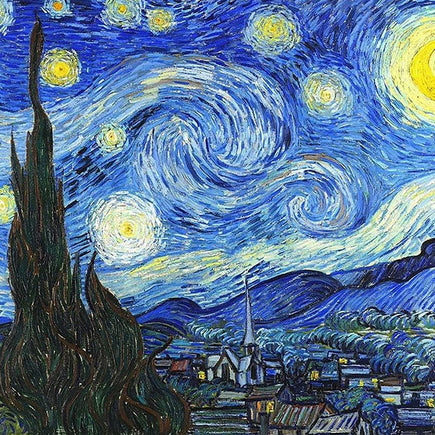
The Swirling Mystery of The Starry Night
The Starry Night is likely the most famous painting in the world today, having been created during Vincent van Gogh's stay at the Saint-Paul-de-Mausole asylum in June 1889. The view is based on his window, but Van Gogh actually painted most of the painting from memory and imagination.

On the left side of the canvas, there is a large cypress tree in an upward, flame-like manner, which was used as a representation of grief during the 19th century. In contrast, the sky doesn’t appear gloomy but instead comes across as turbulent and alive. For any diamond painter you'll find this piece involves a lot of "flow". The circular movement of stars and deep blue swirls create a rhythmic, calming and similar to Vincent's own expressive movements.
Capturing Light in Starry Night Over the Rhône
Before the "swirls" came the "reflections." Painted in Arles in 1888, this work is a masterclass in light. Van Gogh was fascinated by the challenge of capturing the new gas lamps of the city as they shimmered against the dark river water.

If you look closely at the foreground, you’ll see two lovers strolling by the river. This adds a sense of intimacy to an otherwise vast, celestial scene. In the world of diamond art, this painting is a favorite because of the high contrast—the bright gold "drills" representing the stars and lamps pop beautifully against the deep, velvet blues of the night.
The Quiet Resilience of Irises
Van Gogh began Irises within his first week at the asylum. Unlike his later, more tortured works, there is a controlled, almost Japanese-inspired elegance here. There are no thick, black outlines; instead, he used soft, wavy lines and a crowded composition that makes you feel like you are standing right in the center of the garden.

Every iris is unique. The variety of blues and violets ensures that the "drilling" process stays engaging, as each flower reveals its own character as the canvas fills up.
Embracing New Life in Almond Blossoms
This is one of Vincent’s most tender works. He painted it to celebrate the birth of his nephew (whom his brother Theo named Vincent Willem, after the artist). The branches of the almond tree—one of the first to bloom in spring—represent new life and hope.

The composition is heavily influenced by Japanese woodblock prints, featuring a bold teal background and delicate, off-center branches. Because of the large sections of solid color and the intricate detail of the petals, it’s a wonderful choice for those who find "color blocking" to be the most relaxing part of the hobby.
The Radiant Energy of Sunflowers
To Van Gogh, the sunflower was a symbol of gratitude. He painted this series to decorate a room for his friend and fellow artist, Paul Gauguin. Vincent wanted to prove that a painting could be impactful even if it stayed within a very narrow range of colors—in this case, various shades of yellow and ochre.

Working on a Sunflowers project is an exercise in warmth. It challenges the eye to see the subtle differences between gold, amber, and lemon, creating a finished piece that radiates light from within.
Bringing the Museum Home
As Vincent van Gogh put it: “I confess I do not know why, but looking at the stars always makes me dream.” When you spend hours placing every individual, sparkling diamond onto your own reproduction of his work, you are experiencing that dream firsthand. It is more than just a piece of decor; by placing one shimmering facet at a time, you are connecting with the genius of Van Gogh and creating your own lasting masterpiece.